

When you walk through the cooler aisle at a store, you’ll notice big numbers on the boxes like “5-day ice retention,” “holds ice for 10 days,” or “18-day ice retention.”
These claims seem impressive, but what do they really mean?
Can you trust them?
Let’s break down what these claims actually mean.
The Basic Definition
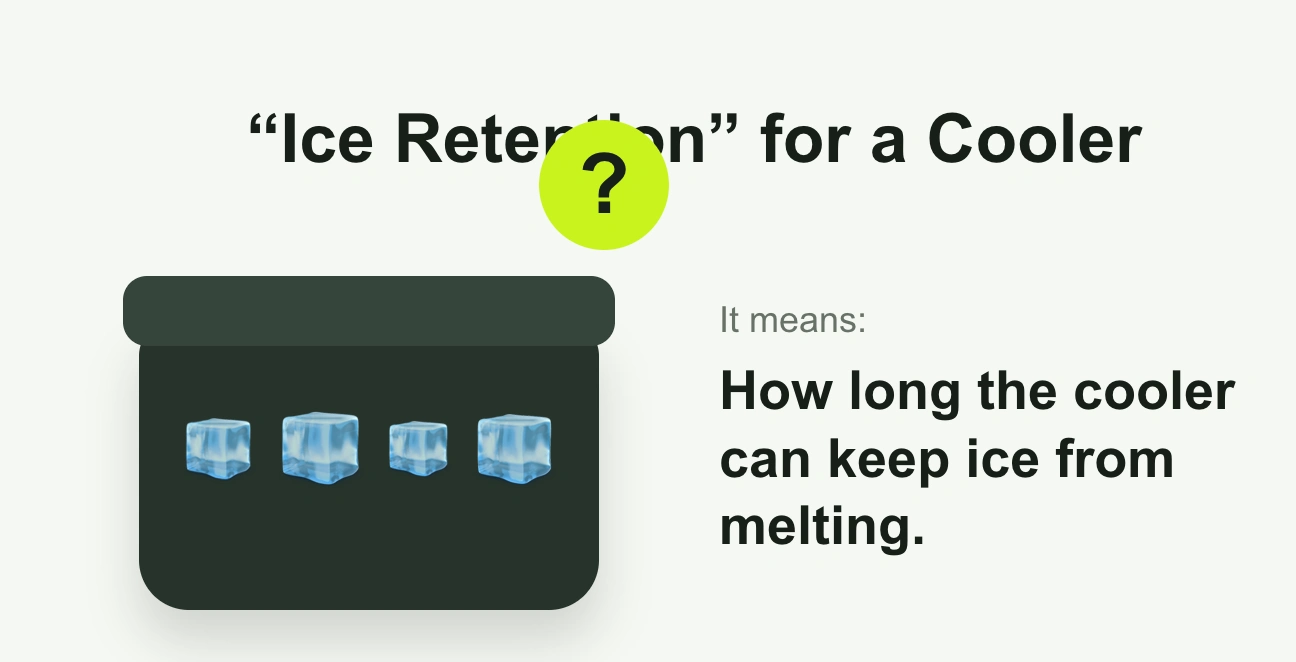
Ice retention is how long a cooler can keep ice from melting. If a cooler has good ice retention, your food and drinks stay cold longer. If it has poor ice retention, the ice melts faster.
That sounds straightforward, but the way companies test ice retention doesn’t match how people actually use coolers.
How Companies Test Ice Retention
Most cooler brands use a standard test. They fill the cooler to the top with cubed ice, close the lid, and leave it closed for the entire test. They never open it. They watch the temperature inside until all the ice is gone.
Some companies test coolers in a 90-degree room with 70% humidity.
Others change the temperature from 90 degrees during the day to 67 degrees at night to mimic summer.
Igloo fills their coolers almost full with ice chilled to 10 degrees Fahrenheit and ends the test when the inside reaches 40 degrees.
The problem is that these tests don’t match real life.
In reality, you open the cooler to get a drink, add warm food, or leave it out in the sun.
You also need space for your food and drinks, so you can’t fill it completely with ice.
So when you see “5-day ice retention” on a box, it really means the cooler lasted for 5 days under perfect lab conditions.
What Actually Affects Ice Retention?
Many things affect how long ice lasts in your cooler. Knowing about these can help you use your cooler better.
1. Cooler Quality
Not all coolers are made the same way. Basic coolers usually keep ice for one or two days. Models with better insulation can last two to four days. High-end rotomolded coolers can keep ice even longer.
Rotomolded coolers are made with thick, seamless walls. Manufacturers add more than twice as much insulation as regular coolers. The thick walls and tight seals help keep cold air inside and block out heat.
Cooler wall thickness matters. Thin walls let outside heat penetrate easily. Some coolers have thermal bridging, where the outer shell touches the inner wall. Heat travels through these contact points, melting the ice faster.
2. Insulation Material
Cooler makers use different kinds of foam for insulation. High-end coolers often use polyurethane foam. Some brands put two inches of closed-cell foam in the lid, sides, and bottom. More insulation helps keep ice longer.
3. Ice Quality and Type
The kind of ice you use matters a lot. Crushed ice melts faster than cubes. Block ice lasts the longest because less of it touches warm air. Ice from your home freezer is usually denser and colder than ice from a store machine.
4. Ice Quantity
Using plenty of ice is the most important way to keep things cold. A cooler packed with ice stays cold longer than one that’s only half full. Empty space lets warm air in and hurts performance.
The standard test uses a 2:1 ratio, meaning you should have two parts ice for every one part of food or drinks.
5. Outside Temperature
A cooler left in 90-degree sun won’t work as well as one kept in the shade. Sunlight heats up the outside, and that heat gets inside. Dark coolers soak up more heat than light-colored ones.
6. Opening the Lid
Each time you open the cooler, cold air leaves and warm air comes in. Ice melts about 60 times faster with the lid open than closed. Leaving the lid open for one minute can cost you an hour of ice retention.
7. Starting Temperature
If you add warm food or drinks, the ice melts quickly as it cools them down. Starting with cold items helps your ice last much longer.
8. Pre-chilling
A warm cooler melts ice fast because the ice has to cool the walls first. If you fill your cooler with ice the night before, it will stay cold longer.
The Science Behind Ice Retention
Coolers don’t make cold air. They just slow down how fast heat gets inside. Heat can enter a cooler in three main ways.

- Conduction is the transfer of heat through the cooler’s walls. Thicker, better-insulated walls slow this process.
- Convection is heat moving through the air. When you open the lid, warm air gets in. Even small gaps around the lid can let air leak inside over time.
- Radiation is heat from the sun warming the cooler’s surface. Light-colored coolers reflect more sunlight than dark ones.
Ice has a special property called latent heat of fusion.
When ice at 32 degrees melts, each gram soaks up 334 joules of heat.
As long as there’s still solid ice, the inside stays near freezing. Once all the ice is gone, the temperature goes up quickly.
How to Maximize Ice Retention
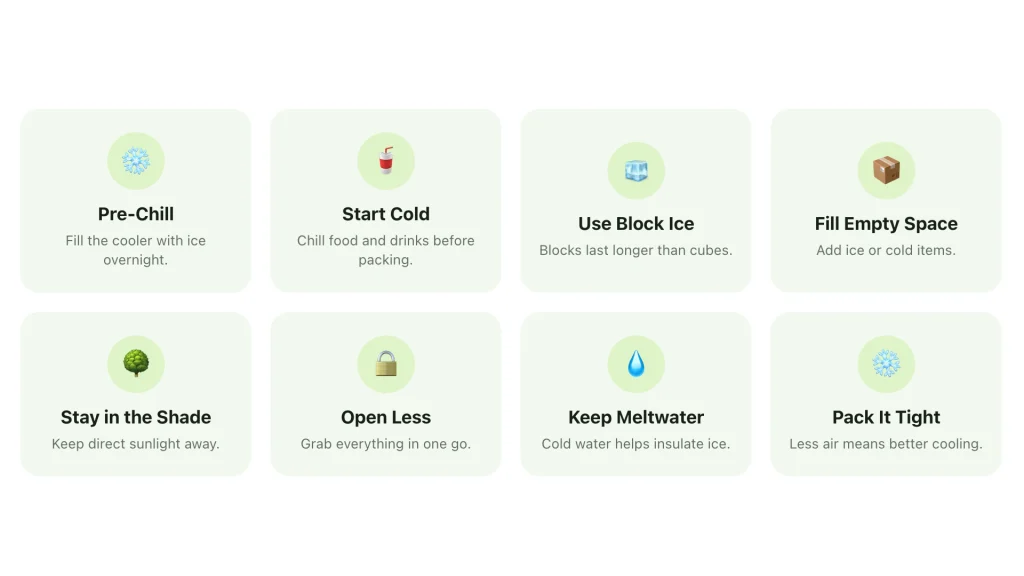
You don’t have to buy the priciest cooler to keep ice longer. Packing your cooler the right way makes a big difference.
- Pre-chill your cooler by filling it with ice the night before your trip.
- Start with cold food and drinks by putting them in the fridge before packing.
- Use block ice, since it lasts longer than ice cubes.
- Fill the cooler as much as possible, using extra ice or cold items to take up empty space.
- Keep your cooler in the shade, since direct sunlight makes it work less effectively.
- Try to open the lid as little as possible. Grab everything you need in one go.
- Don’t drain out the melted water. The cold water helps keep the remaining ice insulated.
Reading Ice Retention Claims
When you see a number on a cooler box, remember it’s the best-case scenario, not a promise. Check the fine print for the testing temperature. If the claim is based on 90 degrees, it’s more realistic than one without a temperature listed.
YETI doesn’t give exact times for ice retention because there are so many factors involved. Other brands do make claims, but those are based on lab tests.
Ice Retention by Cooler Brands
Coolers vary in how well they keep ice. Some brands keep ice for a week, while others last only a day. This depends on their build, insulation, and price.
Here’s how the top cooler brands stack up for ice retention.
1. YETI
YETI is the brand most people think of when they want long ice retention. The company helped create the rotomolded cooler category in 2006. Rotomolded coolers have thick, seamless walls that trap cold air inside.
In independent tests, YETI coolers perform at the top. The YETI Roadie 48 kept food below 40 degrees for 6.8 days and drinks cold for 7.5 days in one test. In another evaluation, the YETI Tundra 45 held ice for the full 10 days of testing.
Consumer Reports tested the YETI Tundra 45 in an 118-degree chamber. It was one of only two coolers that still held ice after 72 hours.
YETI coolers cost more than most competitors. The Tundra 45 sells for about $325. You pay a premium for ice retention, but performance is consistent across tests.
2. RTIC
RTIC builds coolers that compete directly with YETI but at lower prices. The brand has gained a strong reputation for value.
Consumer Reports named the RTIC 52 Quart Ultra-Light Cooler the top pick among six coolers tested. It kept soda below 40 degrees for more than five days inside a 116-degree test chamber. The cooler costs around $207, significantly less than comparable YETI models.
A head-to-head test between YETI and RTIC showed interesting results. After 72 hours, RTIC’s ice had fully melted while YETI still had cubes. Another test found the RTIC Ultralight 52 held ice for about 3 days in real-world conditions.
RTIC claims their Ultra-Light Wheeled Cooler has 2.3 inches of closed foam insulation and can retain ice for up to 4 days.
3. Igloo
Igloo is one of the oldest cooler brands. They offer models at many different price points. Their ice retention varies widely depending on which cooler you buy.
The Igloo BMX 25 maintained temperatures at or below 40 degrees for four days in testing. The Igloo IMX 70qt stayed below 40 degrees for 4.8 days, though Igloo claimed it could do 7 days under controlled conditions.
Igloo tests its coolers by filling them 90% with ice at 10 degrees Fahrenheit. They track how long it takes for the temperature to reach 40 degrees.
Consumer Reports tested the Igloo Latitude 52 Quart Cooler at $50.99. Even after the ice had melted for around 72 hours, the cooler kept the soda at 45 degrees. At 11.7 pounds, it was lighter than almost every other cooler in the test.
The Igloo Trailmate Journey All-Terrain was the last cooler to melt all its ice cubes in a separate test, showing strong cold retention.
4. Coleman
Coleman makes affordable coolers that work well for day trips and weekend outings. They do not match the ice retention of premium rotomolded brands but offer good value for the price.
The Coleman Pro 45 still had solid ice chunks on day four in a 95-degree backyard test with the lid opened twice daily. Coleman claims this model has a 4-day ice retention period.
The Coleman Xtreme 70-Quart is rated for 2 to 3 days of ice retention. The Coleman Classic Series 52 Quart Hard Cooler holds 80 cans but had all its ice melted before temperatures reached the triple digits in Consumer Reports testing.
For shorter trips, Coleman works fine. For week-long camping, you may need to buy ice more often.
5. Pelican
Pelican builds rotomolded coolers with thick insulation. The company claims up to 10 days of ice retention for their Elite models.
Consumer Reports found that the Pelican 50QT Elite Cooler kept contents frozen for four days in a 116-degree test chamber. At 32.2 pounds, it was the heaviest cooler in the test. The cooler costs around $311.
6. Orca
Orca is another rotomolded brand that competes with YETI. Their coolers feature up to 3 inches of insulation.
The Orca 58 Quart maintained safe food temperatures below 40 degrees for 6.7 days in testing. In extreme heat above 100 degrees, one Orca cooler retained about 5% of its ice after four days.
Orca claims their coolers achieve 8 to 10 days of ice retention in ideal conditions.
7. Canyon
Canyon Coolers offers rotomolded options at mid-range prices. The Canyon Outfitter 55 kept temperatures below 40 degrees for 5.2 days in testing. In 100-degree heat, it maintained usable ice for four days.
The 55-quart model costs around $300. Some users report that Canyon does not quite match YETI or Orca for ice retention, but it performs well for most needs.
8. Engel
Engel makes both hard and soft coolers. Their hard coolers have thick insulation in the lid, sides, and bottom.
Engel claims up to 10 days of ice retention for some models. Real-world testing shows more mixed results. One test found the Engel Roll-Top Backpack Cooler kept ice for 4 days. Another reviewer reported visible ice cubes after 6 days.
Some users have been disappointed, with ice melting in under 24 hours. As with any cooler, how you pack and use it makes a big difference.
Brand Comparison Summary
| Brand | Typical Ice Retention | Price Range | Best For |
| YETI | 6-10 days | High ($300+) | Maximum performance |
| RTIC | 3-5 days | Medium ($200) | Value + performance |
| Igloo | 2-5 days | Low-Medium ($50-150) | Budget options |
| Coleman | 1-4 days | Low ($50-100) | Day trips |
| Pelican | 4-10 days | High ($300+) | Extreme conditions |
| Orca | 6-10 days | High ($300+) | Maximum performance |
| Canyon | 4-5 days | Medium ($300) | Balance of price and performance |
| Engel | 3-10 days | Medium-High | Mixed reviews |
What the Numbers Really Mean
The ice retention numbers on cooler boxes are based on lab tests. Companies fill the cooler completely with ice, close the lid, and leave it shut. They do not open it to grab drinks or add warm food.
Real-world results are always lower. A cooler rated for 10 days in a lab might give you 5 or 6 days in actual use. That is impressive, but you should not expect the box number to match your experience.
The brand matters, but so does how you use the cooler. Pre-chilling, using block ice, and keeping the lid closed all help any brand perform better.
Final Word
Ice retention shows how long a cooler keeps ice frozen. The numbers on the box are from ideal lab tests. In real life, results depend on your cooler’s quality, the kind and amount of ice, outside temperature, how often you open the lid, and how you pack it.
Knowing about ice retention helps you choose the right cooler and use it well. A $50 cooler packed and used properly can work better than a $300 cooler used the wrong way. Focus on the details, and your ice will last longer than you think.


Join the discussion
Own this product or tested an alternative? Share your experience to help other readers decide.