

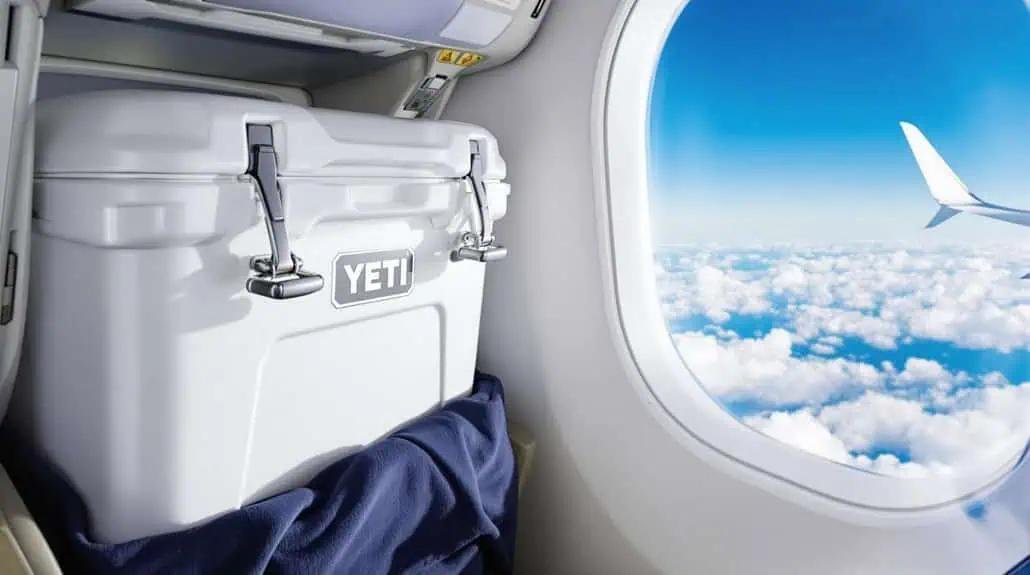
Yes, you can bring a cooler on a plane. The Transportation Security Administration (TSA) specifically lists an empty cooler as allowed in both carry-on and checked baggage. You can also travel with food, frozen items, and ice packs in many situations.
The challenge is that you need to follow two different sets of rules.
First, your cooler and what’s inside must meet airport security rules.
Second, if you want to bring it into the cabin, it has to fit your airline’s size and weight limits.
For example, American Airlines limits a standard carry-on to 22 × 14 × 9 inches, including wheels and handles, while Southwest allows carry-on bags up to 24 × 16 × 10 inches.
So, can you take your favorite cooler on your next flight? Most of the time, yes. Whether you can carry it on, check it, or pack food and ice inside depends on its size and what you put in it.
Here’s what you should know before bringing a cooler to the airport.
Can You Bring a Cooler on a Plane?
Yes. An empty cooler can generally travel in either your carry-on baggage or checked baggage.
The TSA’s current list specifically marks “Cooler (empty)” as permitted in both carry-on and checked bags.
But just because TSA allows coolers doesn’t mean you can bring any size into the cabin.
Your airline controls the size and weight limits for carry-on baggage. The cooler must fit within those limits and be able to be stored under the seat or in the overhead compartment.
The Federal Aviation Administration (FAA) says the maximum carry-on size for most airlines is around 45 linear inches, meaning the total of the bag’s height, width, and depth. The FAA also recommends checking your airline’s specific rules before traveling.
The International Air Transport Association (IATA) gives 56 × 45 × 25 cm (22 × 18 × 10 inches) as a general reference used by many airlines, but it stresses that baggage allowances remain airline-specific.
This means your cooler might get through TSA but still be too big to use as a carry-on.
The simple rule

TSA decides if your cooler and its contents can go through security. Your airline decides if it can travel in the cabin.
Can You Bring a Cooler as a Carry-On?
Yes, as long as the cooler meets your airline’s carry-on requirements.
A small soft-sided cooler is usually easiest since it’s lighter and more flexible than a hard-sided one.
A hard-sided cooler can work too, as long as its outside size fits your airline’s limits.
Before leaving for the airport, measure the cooler from its widest points. Include:
- Handles
- Wheels
- Exterior pockets
- Attachments
- Other parts that increase its overall dimensions
For example, American Airlines says a carry-on cannot exceed 22 × 14 × 9 inches, including handles and wheels. The bag must also fit in the airport’s baggage sizer.
Southwest currently allows a larger carry-on size of 24 × 16 × 10 inches, and its policy also states that wheels, handles, and attachments count toward the dimensions.
This difference matters.
A cooler that fits Southwest’s size limit might not fit American Airlines’ limit.
Carry-on cooler size comparison

| Airline | Maximum Carry-On Size |
| American Airlines | 22 × 14 × 9 in |
| Southwest Airlines | 24 × 16 × 10 in |
| Many airlines | Around 22 × 18 × 10 in as a general reference |
| FAA general reference | 45 linear inches |
Airline rules can change, and some flights may have extra restrictions. Always check with your airline before you pack.
Can a Cooler Count as Your Personal Item?
Sometimes.
A personal item is smaller than a normal carry-on and normally needs to fit under the seat in front of you.
For example, American Airlines says personal items cannot exceed 18 × 14 × 8 inches and must fit under the seat.
A small soft cooler that fits those dimensions may be able to travel as your personal item.
But don’t assume a cooler counts as a personal item just because it’s small.
The airline’s definition and the available space on your aircraft still matter.
Small cooler vs. carry-on cooler
A useful way to think about it is:
Small soft cooler: Potential personal item
Medium cooler: Potential carry-on
Large hard cooler: Usually better suited to checked baggage
If you want to avoid checking bags, measure your cooler before your trip instead of just looking at its quart size.
Does Cooler Capacity Determine Whether It Can Be a Carry-On?
No.
A cooler’s size in quarts—like 20, 50, or 80—doesn’t tell you if it meets airline carry-on rules.
Airlines measure the cooler’s physical dimensions, not just its internal storage capacity.
For example, two 50-quart coolers can have different exterior dimensions because of differences in insulation thickness, wall construction, handles, wheels, and lid design.
This is especially important with large rotomolded coolers.
A cooler can have a relatively compact internal capacity but still exceed the airline’s maximum exterior dimensions because of thick insulated walls.
Before flying with a cooler, check these three numbers:
- Length
- Width
- Height
Then compare them with your airline’s published baggage limit.
Don’t just go by the cooler’s quart rating.
Can You Bring Food Inside a Cooler on a Plane?

Yes, you can bring many types of food in a cooler.
TSA generally allows solid food in both carry-on and checked baggage. Its current guidance lists items such as solid cheese, cooked meat, seafood, bread, snacks, and other solid foods as permitted.
The main thing to check is whether your food counts as a solid, liquid, or gel.
Solid foods are generally easier
Examples include:
- Sandwiches
- Cooked meat
- Seafood
- Solid cheese
- Bread
- Crackers
- Cookies
- Fresh eggs
- Frozen meat
- Frozen vegetables
- Solid snacks
TSA says meat, seafood, and other non-liquid foods can travel in both carry-on and checked baggage.
So you can use a cooler to keep many perishable foods cold during your trip.
But there is an important catch.
What About Liquid or Gel Food?
Liquid and gel foods are subject to different rules when carried through airport security.
The familiar TSA 3-1-1 liquids rule generally limits liquids, gels, aerosols, creams, and pastes in carry-on baggage to containers of 3.4 ounces (100 mL) or less.
This can affect foods that people commonly put inside coolers.
Examples include:
- Yogurt
- Soup
- Sauces
- Salsa
- Salad dressing
- Peanut butter
- Creamy cheese
- Maple syrup
- Juice
TSA’s current guidance lists these items under the 3.4-ounce/100 mL carry-on restriction.
So, a cooler packed with sandwiches and frozen meat is different from one filled with big containers of yogurt or sauce.
A simple way to remember it
Solid food: Generally allowed.
Liquid or gel food over 3.4 oz/100 mL: Generally not allowed in a carry-on through the security checkpoint.
Liquid or gel food within the applicable limit: May be allowed.
Checked baggage: Larger quantities of many liquid foods can generally be packed there, subject to other restrictions.
Can You Bring Ice in a Cooler on a Plane?
Yes, but the condition of the ice matters.
TSA allows frozen liquid items through the security checkpoint when they are completely frozen solid at the time of screening.
If the ice has started melting and there is liquid at the bottom of the container, the liquid must comply with the applicable liquids restrictions.
This is one of the most important things to remember when flying with a cooler.
1. Frozen ice
Generally allowed through security.
2. Partially melted ice
May be subject to the liquids rules.
3. Liquid water
Subject to the liquids restrictions for carry-on baggage.
If you want to bring ice through security, avoid leaving your cooler in a warm car for hours before you get to the airport.
Pack the ice as close to the security checkpoint as practical and keep it completely frozen.
Can You Bring Ice Packs on a Plane?
Yes.
TSA allows frozen liquid items and gel packs through the checkpoint when they are frozen solid at the time of screening.
This is why reusable freezer packs are a good choice if you want to keep food cold without using loose ice.
However, partially melted packs are different.
If a freezer pack is:
- Slushy
- Partially melted
- Filled with visible liquid
it may have to comply with the applicable liquid restrictions.
Best way to pack ice packs
Freeze them completely before leaving home.
Then:
- Keep them inside the cooler.
- Keep the cooler closed as much as possible.
- Take the cooler out for screening if requested.
- Tell the TSA officer if you have frozen food or ice packs.
- Be prepared for additional screening.
TSA also notes that officers may ask travelers to separate food and other items from carry-on bags because they can obstruct clear X-ray images.
Can You Bring Frozen Food in a Cooler?
Yes, frozen food can generally travel in either carry-on or checked baggage.
TSA specifically allows frozen meat, seafood, vegetables, and other non-liquid foods. When packed with ice or ice packs, those cooling materials must be completely frozen when they go through security.
This can make a cooler useful for transporting:
- Frozen meat
- Seafood
- Frozen vegetables
- Frozen meals
- Other frozen perishables
The hard part is keeping everything frozen for your whole trip.
Remember that airport security rules and food safety are separate concerns.
A food item may be permitted through security but still become unsafe to eat if it remains at an unsafe temperature for too long.
For long trips, consider the total travel time, including:
- Drive to the airport
- Parking
- Security
- Waiting at the gate
- Boarding
- Flight
- Baggage claim
- Drive to your destination
A cooler that works fine for a short drive might need a different packing plan for a long day of air travel.
Can You Bring Meat or Seafood in a Cooler?
Yes. TSA allows meat, seafood, and other non-liquid foods in both carry-on and checked baggage.
If you’re packing meat or seafood with ice or freezer packs, make sure the cooling material is frozen solid when you reach the security checkpoint.
For example, you could pack:
Cooler → frozen seafood → sealed food bags → frozen gel packs
This keeps the contents organized and makes inspection easier if TSA asks to examine the cooler.
For international travel, however, there is another issue.
Airport security approval does not mean the destination country will allow the food into the country.
Customs and agricultural authorities may have separate restrictions on meat, seafood, dairy, fruits, vegetables, and other food products.
If you’re flying internationally, check your destination’s import rules before packing food.
Can You Bring Dry Ice in a Cooler on a Plane?
Yes, but dry ice has stricter rules than ordinary ice.
The FAA allows dry ice for packing perishables, but the quantity is limited to 2.5 kg (5.5 lb) per passenger and per package. Airline approval is required. The package must also allow carbon dioxide gas to escape and must not be airtight.
For checked baggage, the package must also be appropriately marked with information such as “Dry Ice” or “Carbon Dioxide, Solid” and the amount of dry ice.
Dry ice rules at a glance
| Requirement | Rule |
| Maximum amount | 5.5 lb / 2.5 kg |
| Airline approval | Required |
| Container | Must allow gas to vent |
| Airtight container | Not permitted |
| Checked baggage | Must have required markings |
| Purpose | Used to keep perishables cold |
Do not simply put a large block of dry ice into a sealed cooler and head to the airport.
Dry ice changes directly from a solid into carbon dioxide gas. A completely airtight container can allow pressure to build.
If you plan to use dry ice, check your airline’s instructions before your trip and follow the FAA’s packaging requirements.
Can You Check a Cooler on a Plane?
Yes. A cooler can generally be checked as baggage if it meets the airline’s checked-baggage size, weight, and packing requirements.
It usually makes more sense to check your cooler if it’s too big for your airline’s cabin baggage limit.
A large hard-sided cooler may be much easier to transport as checked baggage than trying to squeeze it into an overhead compartment.
IATA notes that checked-baggage allowances vary by airline and route. It also says international guidelines recommend individual checked bags not exceed 23 kg (50 lb) for occupational health and safety reasons, while many regions set a maximum of 32 kg (70 lb) for a single checked bag.
These are not universal free-baggage allowances. Your airline may have a lower weight limit, a different size limit, or a baggage fee.
Before checking a cooler, verify:
- Maximum weight
- Maximum dimensions
- Checked-bag fees
- Oversize fees
- Whether the cooler is accepted as baggage
- Whether food or perishables have additional requirements
Should You Carry On or Check Your Cooler?
The best choice depends on the cooler’s size and what you’re carrying.
| Situation | Better Option |
| Small soft cooler | Carry-on or personal item |
| Cooler within airline dimensions | Carry-on |
| Large hard-sided cooler | Checked baggage |
| Large amount of frozen food | Checked baggage may be easier |
| Valuable or fragile food | Carry-on when permitted |
| Cooler with dry ice | Check airline requirements first |
A carry-on cooler gives you more control over the contents.
A checked cooler gives you more space.
For expensive seafood, specialty foods, medication-related food products, or other items you do not want handled roughly, carrying the cooler into the cabin may be preferable if the airline permits it.
Soft-Sided vs. Hard-Sided Coolers for Air Travel
The kind of cooler you pick can make a big difference.
1. Soft-Sided Coolers
Soft-sided coolers are often better for air travel because they are:
- Lightweight
- Easier to carry
- More flexible
- Easier to fit under seats
- Easier to squeeze into limited spaces
A soft cooler can be especially useful for snacks, drinks, lunch, or a small amount of frozen food.
2. Hard-Sided Coolers
Hard coolers offer different advantages:
- Better protection
- More durable construction
- Better protection for fragile food
- More rigid insulation
- Better structure for longer trips
The downside is simple: they take up more fixed space.
A large hard-sided cooler that is perfect for camping may be completely unsuitable as a cabin bag.
That is why cooler dimensions matter more than cooler capacity when you’re flying.
What Size Cooler Is Best for Flying?
There is no universal “airline cooler size.”
Instead, choose a cooler based on the baggage allowance of the airline you are actually flying.
For example, a cooler intended for American Airlines should stay within its 22 × 14 × 9-inch carry-on limit.
A cooler intended for Southwest can potentially be larger because Southwest currently allows 24 × 16 × 10 inches for carry-on baggage.
If you often fly with a cooler, a small soft-sided one that fits most cabin baggage limits is usually the easiest option.
For road trips, hunting trips, fishing trips, or camping vacations where you need a large cooler, checking it may be more practical.
Can You Bring a Cooler With Wheels on a Plane?
Yes, potentially.
Having wheels doesn’t automatically mean your cooler isn’t allowed.
What matters most is the cooler’s total size.
American Airlines includes wheels and handles when measuring its 22 × 14 × 9-inch carry-on limit. Southwest also counts wheels, handles, and attachments toward its carry-on dimensions.
So if your cooler is advertised as 22 × 14 × 9 inches but the wheels extend beyond those dimensions, the airline may consider the actual larger measurement.
Measure the cooler when it is fully assembled and ready for travel.
What About a Large Rotomolded Cooler?
Large rotomolded coolers are usually better suited to checked baggage than cabin travel.
They are designed for durability, insulation, and long-term cold retention rather than fitting into an aircraft’s overhead bin.
A large rotomolded cooler may also have:
- Thick insulated walls
- Heavy-duty handles
- Hinges
- Large latches
- Wheels
- Exterior accessories
- Drain plugs
All these features can make the cooler bigger and heavier.
If you’re traveling with a large cooler, don’t assume that because it is marketed as “portable,” it will qualify as a carry-on.
Measure it against your airline’s actual baggage limits.
Airline Rules Matter More Than Cooler Marketing Claims
A cooler manufacturer might describe a product as:
- Travel-friendly
- Portable
- Compact
- Carry-on size
- Airline-friendly
But these descriptions do not override airline baggage rules.
The airline’s published dimensions are what matter at the airport.
IATA specifically states that baggage allowances and conditions of carriage remain airline-specific. Carry-on allowances can vary based on airline, cabin class, aircraft type, and other factors.
That’s why the safest way is to:
Choose cooler → Measure cooler → Check airline → Check TSA rules → Pack accordingly
Not:
Buy cooler → Arrive at airport → Hope it fits
Can You Bring a Cooler on an International Flight?
Yes, but international flights add another set of rules.
You need to consider:
- Airport security
- Airline baggage rules
- Destination customs rules
- Agricultural or food-import regulations
The TSA rules apply to security screening in the United States. They do not determine what another country will allow you to import.
For example, a country may restrict or prohibit certain:
- Meat products
- Dairy products
- Fresh fruit
- Vegetables
- Seafood
- Seeds
- Animal products
So if you are taking food in a cooler internationally, check the destination country’s customs and agriculture requirements before you travel.
A food item can be perfectly acceptable at the security checkpoint and still be prohibited when you arrive.
How to Pack a Cooler for Air Travel
Once you know your cooler is allowed, packing it the right way can make your airport experience much smoother.
1. Measure the Cooler
Measure the exterior, not the interior.
Include:
- Handles
- Wheels
- Attachments
- Pockets
- Other protruding parts
Compare those measurements with your airline’s current baggage limits.
2. Freeze Your Ice Packs Completely
If you’re using freezer packs, freeze them solid before going to the airport.
TSA allows frozen liquid items and gel packs when they are completely frozen at screening.
3. Keep Food Sealed
Use leak-resistant bags or containers.
This helps prevent:
- Leaks
- Odors
- Messes
- Food contamination
- Problems during inspection
4. Separate Liquids
Don’t think that putting a big bottle of yogurt or sauce in a cooler means it’s exempt from the liquids rules.
The cooler doesn’t change how TSA classifies what’s inside.
5. Keep the Cooler Organized
TSA might ask you to take out food or other items for extra screening. Keeping things organized makes this easier.
6. Label the Cooler
If you’re checking it, add your name and contact information.
A large cooler can look similar to many other pieces of outdoor equipment at baggage claim.
7. Don’t Overfill It
If your cooler is hard to close at home, it’ll be even tougher to handle at the airport.
Leave enough room for proper packing and secure closure.
Can You Bring a Cooler Through TSA With Food and Ice?
Yes, in many cases.
Here’s the simplest breakdown:
| Cooler Contents | Carry-On? | Key Rule |
| Empty cooler | Yes | TSA allows it |
| Solid food | Yes | Generally permitted |
| Frozen food | Yes | Generally permitted |
| Frozen ice packs | Yes | Must be frozen solid |
| Frozen ice | Yes | Must be frozen solid |
| Partially melted ice | Restricted | Liquid rules may apply |
| Large liquid food | Usually no | 3.4 oz/100 mL rule |
| Dry ice | Yes, with restrictions | FAA limits apply |
TSA’s current guidance confirms that an empty cooler is permitted in both carry-on and checked bags, while frozen food and properly frozen ice packs can also travel with you.
The main thing to remember is that TSA checks the cooler and everything inside it separately.
What Should You Do at the Security Checkpoint?
If you’re flying with a cooler, be ready for possible extra screening.
Keep the cooler easy to open.
If the officer asks about the contents, explain what you have packed.
For example:
“This cooler contains frozen food and completely frozen ice packs.”
TSA officers may ask travelers to remove food or other items from a carry-on because they can interfere with X-ray screening.
Don’t be surprised if your cooler gets extra inspection.
The TSA also states that the final decision on whether an item is allowed through the checkpoint rests with the TSA officer.
The Biggest Mistake Travelers Make
The biggest mistake is assuming:
“TSA allows coolers, so any cooler can be a carry-on.”
But that’s not how the rules work.
TSA allows an empty cooler in both carry-on and checked baggage. But the airline can still require a cooler that is too large to be checked.
For example, a huge 80-quart cooler might be perfectly legal to own and transport, but it is unlikely to fit inside an aircraft’s overhead compartment.
The same principle applies to a cooler filled with food.
The cooler may be allowed, while one of its contents may not meet carry-on restrictions.
Quick Checklist Before Flying With a Cooler
Before heading to the airport, check these items:
- Measure the cooler
- Include wheels and handles
- Check your airline’s carry-on dimensions
- Check personal-item dimensions if applicable
- Freeze ice packs completely
- Check liquid and gel food quantities
- Keep food sealed
- Check dry-ice restrictions if applicable
- Check checked-bag weight limits
- Check international food-import rules
- Keep the cooler easy to inspect
- Check your airline’s current baggage policy before departure
Using this checklist can help you avoid problems with your cooler at the airport.
Airline-by-Airline Cooler Rules
One of the easiest ways to avoid problems at the airport is to check your airline’s baggage rules before you leave home.
No single cooler size is accepted as a carry-on by every airline. Each airline sets its own baggage limits, and those limits can also vary by ticket type, cabin, aircraft, and route.
Here are some common examples.
American Airlines
American Airlines allows a carry-on bag up to 22 × 14 × 9 inches, including handles and wheels. Personal items can be up to 18 × 14 × 8 inches and must fit under the seat. (aa.com)
A small soft-sided cooler may work as a personal item if it fits the airline’s personal-item requirements.
A larger cooler that exceeds those dimensions should be considered for checked baggage instead.
Southwest Airlines
Southwest allows carry-on bags up to 24 × 16 × 10 inches. Measurements include wheels, handles, and attachments.
This gives travelers slightly more space than the 22 × 14 × 9-inch limit used by several major U.S. airlines.
Still, it’s best to measure your cooler instead of assuming it will fit.
Delta Air Lines
Delta’s standard carry-on size is generally 22 × 14 × 9 inches, including wheels and handles.
Delta also notes that carry-on baggage must fit in the overhead compartment or another approved storage area.
If your cooler is too large, you may need to check it.
United Airlines
United’s carry-on rules depend partly on the fare purchased.
Standard carry-on dimensions are generally 22 × 14 × 9 inches, including wheels and handles. However, some Basic Economy fares restrict full-size carry-on bags, depending on the route.
That means you should check both:
- Your ticket type
- Your specific flight’s baggage allowance
A cooler that fits the physical dimensions can still be subject to fare-based restrictions.
JetBlue
JetBlue’s carry-on allowance can also depend on the fare and itinerary.
This is another reason not to rely on a generic “airline-approved cooler” claim. Check the airline’s current baggage policy for your specific booking.
Airline Cooler Size Comparison
The following table gives a quick reference for common U.S. carriers.
| Airline | Typical Maximum Carry-On Size | What It Means for Coolers |
| American Airlines | 22 × 14 × 9 in | Small/medium cooler may work |
| Delta Air Lines | 22 × 14 × 9 in | Small/medium cooler may work |
| United Airlines | 22 × 14 × 9 in | Check fare restrictions |
| Southwest Airlines | 24 × 16 × 10 in | Allows a little more space |
| JetBlue | Airline/fare dependent | Check current policy |
These measurements should be treated as a planning reference, not a permanent guarantee. Airline baggage policies can change.
Always verify the current rules with the airline operating your flight.
Can I Bring a 50-Quart Cooler on a Plane?
This is a common question, especially among campers, hunters, anglers, and travelers who want to bring food for a long trip.
The answer depends on the cooler’s actual exterior dimensions.
A 50-quart cooler is not automatically prohibited from being a carry-on. But many 50-quart hard-sided coolers are larger than typical cabin baggage limits.
For example, a cooler could hold 50 quarts internally but have exterior dimensions that exceed the airline’s maximum carry-on size.
That’s why the quart rating alone doesn’t answer the question.
Check the dimensions instead
Suppose your cooler measures:
28 × 16 × 16 inches
It would exceed a 22 × 14 × 9-inch carry-on allowance by a substantial amount.
The same cooler may still be perfectly suitable as checked baggage if it meets the airline’s checked-bag requirements.
What about an 80-quart cooler?
An 80-quart cooler will generally be even more difficult to use as a cabin bag.
Large coolers are usually designed for:
- Camping
- Hunting
- Fishing
- Tailgating
- Long road trips
- Outdoor events
These coolers prioritize capacity and insulation rather than aircraft cabin dimensions.
For air travel, a small cooler or soft-sided model is usually more practical.
Can You Bring a Cooler Full of Drinks on a Plane?
This depends on the drinks.
The cooler itself isn’t the problem. The liquid inside it is.
A bottle of water, soda, juice, or another drink larger than the permitted carry-on liquid quantity generally cannot pass through the security checkpoint.
The TSA’s standard liquids rule limits most carry-on liquids to 3.4 ounces (100 mL) per container, with limited exceptions. (tsa.gov)
So you generally cannot fill a cooler with full-size bottles of water and expect to take them through security.
What you can do instead
Bring the cooler empty through security and purchase drinks after the checkpoint.
This is often the easiest way to do it.
You can then place the drinks in your cooler after passing through security.
Can You Bring a Cooler With Bottled Water?
Not if the bottles contain more than the permitted carry-on liquid amount and you are taking them through the security checkpoint.
A full-size bottle of water is a liquid, regardless of whether it is inside a cooler.
The cooler does not change the TSA classification.
However, you can generally:
- Bring the empty cooler through security.
- Pass the checkpoint.
- Purchase bottled water inside the secure area.
- Put the water into your cooler.
This is a simple way to use a cooler without running into the liquids restriction.
Can You Bring Baby Food or Breast Milk in a Cooler?
There are important exceptions for certain infant and child-related items.
TSA allows reasonable quantities of breast milk, formula, toddler drinks, and baby food in carry-on baggage even when they exceed the normal 3.4-ounce liquid limit.
These items do not have to fit inside the standard quart-sized liquids bag.
TSA also allows ice packs, freezer packs, frozen gel packs, and other cooling accessories needed to keep these items cold.
Parents can therefore use a cooler or insulated bag to keep breast milk and other qualifying items cold during travel.
Important point
Tell the TSA officer that you are carrying medically or nutritionally necessary liquids for an infant or child.
These items may receive additional screening, but the normal 3.4-ounce rule does not apply in the same way.
TSA recommends informing officers about these items at the beginning of the screening process. (tsa.gov)
Can You Bring Medication in a Cooler?
Some temperature-sensitive medications need to remain refrigerated during travel.
TSA allows medically necessary liquids and other medical items that exceed normal liquid limits, although they may require additional screening.
If you’re using a cooler to transport medication, keep the medication properly packaged and make it easy to identify during security screening.
You should also check:
- Your airline’s requirements
- TSA’s medical-item guidance
- The medication manufacturer’s temperature requirements
- Rules for your destination if traveling internationally
Don’t assume a regular cooler will keep your medication at the right temperature for your whole trip.
Can You Bring Dry Ice in Checked Baggage?
Dry ice can be transported in checked baggage under FAA conditions.
The FAA limits dry ice to 5.5 pounds (2.5 kg) per passenger and per package when used to keep perishables cold. The packaging must allow carbon dioxide gas to escape. (faa.gov)
The package must also be properly marked.
Because airline procedures can vary, contact your airline before traveling with dry ice.
Why does dry ice need special treatment?
Regular ice melts into water.
Dry ice changes directly from solid carbon dioxide into carbon dioxide gas.
That gas needs somewhere to escape.
A sealed container can build up dangerous pressure.
Never seal dry ice inside an airtight container.
How Long Will Food Stay Cold in a Cooler During Air Travel?
Airport security rules tell you if you can bring something, but they don’t guarantee your food will stay cold.
That’s where cooler performance matters.
Cold retention depends on factors such as:
- Cooler insulation
- Outside temperature
- Starting food temperature
- Amount of ice
- Type of ice
- How often the cooler is opened
- Empty space inside the cooler
- Duration of the trip
A well-insulated cooler can keep food cold for many hours, but air travel adds several periods where temperature can rise.
You may spend several hours:
- Driving to the airport
- Waiting in security
- Sitting at the gate
- Boarding
- Flying
- Waiting for baggage
- Traveling to your final destination
So, pack your cooler with your whole travel day in mind, not just the flight itself.
How to Keep a Cooler Cold During a Flight
If your goal is to keep food frozen or chilled throughout your journey, preparation matters.
1. Pre-Chill the Cooler
Cool the interior before packing it.
A warm cooler has to spend part of its cooling capacity bringing its own walls and interior down to temperature.
2. Start With Cold Food
Don’t put warm food into the cooler immediately before leaving.
Start with food that is already refrigerated or frozen when appropriate.
3. Use Frozen Ice Packs
Completely frozen packs can help maintain low temperatures while avoiding the water mess that comes from loose ice.
4. Minimize Empty Space
Air inside a cooler can warm faster than a tightly packed load of cold food.
Fill unused spaces with appropriate frozen packs or other suitable cooling material.
5. Keep the Lid Closed
Every time you open the cooler, warm air enters.
At an airport, you may be tempted to open the cooler repeatedly.
Keep it closed as much as you can.
6. Use a High-Performance Cooler for Long Trips
If you have a long journey, cooler insulation becomes more important.
A heavily insulated cooler can provide more thermal protection than a thin lunch bag.
But keep in mind that more insulation usually means your cooler will be bigger and heavier.
Can a Cooler Leak on a Plane?
It can, especially if you use loose ice that melts during the trip.
A leaking cooler can cause problems whether it’s in the cabin or checked baggage.
To reduce the risk:
- Use sealed food containers.
- Use frozen gel packs.
- Drain excess water when permitted.
- Keep food in waterproof bags.
- Make sure your cooler closes tightly.
- Avoid packing liquids that are not necessary.
A waterproof cooler is particularly useful when transporting frozen or chilled food for an extended journey.
Should You Put Ice Inside a Checked Cooler?
You can use ice or frozen cooling packs, but consider what happens during the journey.
Regular ice eventually melts.
If your cooler isn’t fully leakproof, melted water can spill into your luggage or onto baggage equipment.
Frozen gel packs are often easier to manage.
If using dry ice, follow the FAA’s specific requirements instead of treating it like ordinary ice.
What Happens if Your Cooler Is Too Big for Carry-On?
If your cooler does not fit the airline’s carry-on requirements, several things can happen.
The airline may require you to:
- Check the cooler
- Pay a checked-bag fee
- Pay an oversized-bag fee
- Transfer the contents to another bag
- Leave the cooler behind if it cannot be accepted
The exact outcome depends on the airline and flight.
That’s why it’s important to measure your cooler before you get to the airport.
Don’t wait until boarding to find out your cooler doesn’t fit.
Can You Take an Empty Cooler Through Airport Security?
Yes.
This is one of the easiest cooler-related rules.
TSA lists an empty cooler as allowed in both carry-on and checked baggage.
An empty cooler can be handy if you want to buy food or drinks after security.
For example:
Home → Empty cooler → TSA checkpoint → Buy food/drinks → Pack cooler → Flight
This way, you avoid most of the hassles with bringing liquids through security.
Can You Bring a Cooler on a Plane for Camping?
Yes, but a camping cooler can be much larger than a typical cabin bag.
If you’re flying to go camping, consider your whole trip from start to finish.
A large cooler may be useful once you reach the campsite but difficult to transport through an airport.
You have two practical choices:
Option 1: Travel With a Small Cooler
Use a compact cooler for the flight and buy food or drinks after arriving.
Option 2: Check a Large Cooler
Use your full-size camping cooler as checked baggage if the airline accepts its dimensions and weight.
The second option is better if you need your cooler right after you arrive and don’t want to buy a new one at your destination.
Can You Bring a Cooler on a Plane for Hunting or Fishing?
Yes, but large hunting and fishing coolers usually make more sense as checked baggage.
Hunters and anglers often need larger coolers for:
- Meat
- Fish
- Seafood
- Frozen food
- Game
- Ice
The cooler’s physical size and weight become the main concerns.
If you’re transporting meat or seafood internationally, you also need to check the destination country’s import regulations.
Airport security is only one part of the process.
Is It Better to Use a Soft Cooler for Air Travel?
For many travelers, yes.
Soft coolers have several advantages in an airport:
They are lighter.
A cooler that weighs several pounds before you put anything inside can quickly become difficult to carry.
They are flexible.
Some soft coolers can fit into tight spaces more easily than rigid coolers.
They are easier to store.
A compact soft cooler may fit under a seat or inside another piece of luggage, depending on its dimensions.
They are convenient for short trips.
For lunch, snacks, drinks purchased after security, or a small amount of chilled food, a soft cooler may be all you need.
Hard coolers still have an important place, especially for long trips and outdoor activities.
The right choice depends on the purpose.
Soft Cooler vs. Hard Cooler for Flying
| Feature | Soft Cooler | Hard Cooler |
| Weight | Usually lighter | Usually heavier |
| Flexibility | High | Low |
| Cabin travel | Often easier | More difficult when large |
| Durability | Moderate to high | Usually high |
| Food protection | Good | Excellent |
| Large capacity | Less practical for cabin | Better for checked travel |
| Camping use | Good | Excellent |
| Long-term cold retention | Model-dependent | Often better |
For a short flight, a soft cooler is often more convenient.
For a long camping trip after the flight, a hard-sided cooler may make more sense.
What Is the Best Way to Travel With a Large Cooler?
If you need a large cooler for your destination, treat it like checked luggage.
Before traveling:
- Check the airline’s maximum checked-bag dimensions.
- Check the maximum weight.
- Check baggage fees.
- Measure the cooler.
- Empty unnecessary accessories.
- Secure the lid.
- Protect fragile parts.
- Label the cooler.
- Check whether your airline has special requirements for coolers.
- Pack perishables according to applicable food-safety and security rules.
A large cooler can be very useful once you arrive, but it’s rarely the easiest thing to carry through an airport.
Cooler Packing Mistakes to Avoid
Mistake 1: Measuring Only the Interior
Airlines care about exterior dimensions.
Measure the outside.
Mistake 2: Assuming “50 Quart” Means Carry-On
Quart capacity does not determine airline eligibility.
Dimensions do.
Mistake 3: Packing Melted Ice
Melted ice becomes liquid.
Freeze it solid before security.
Mistake 4: Forgetting About Handles and Wheels
Those parts count toward the overall dimensions for many airline baggage policies.
Mistake 5: Packing Large Drinks
A cooler doesn’t exempt liquids from airport security restrictions.
Mistake 6: Ignoring the Operating Airline
If your ticket involves multiple airlines, don’t assume every carrier follows the same baggage rules.
Mistake 7: Forgetting Customs Rules
International travelers need to check destination-country food restrictions.
Mistake 8: Using an Airtight Container for Dry Ice
Dry ice produces carbon dioxide gas.
Follow FAA packaging requirements and never seal dry ice in an airtight container.
Frequently Asked Questions About Bringing Coolers on Planes
Can I bring an empty cooler on a plane?
Yes. TSA allows empty coolers in both carry-on and checked baggage. The airline’s baggage size and weight rules still apply.
Can I bring a cooler as a carry-on?
Yes, if the cooler fits your airline’s carry-on size and weight requirements. TSA permission for the cooler does not override the airline’s baggage limits.
Can I bring a small cooler as a personal item?
Potentially. It must meet your airline’s personal-item dimensions and fit in the required storage space.
Can I bring food in a cooler on a plane?
Yes. Many solid foods are allowed in carry-on baggage. Liquids and gels are subject to additional restrictions.
Can I bring frozen food in a cooler?
Yes. TSA generally allows frozen food in carry-on and checked baggage. Frozen ice packs should remain completely frozen when presented for screening.
Can I bring ice packs through TSA?
Yes, if the ice packs are completely frozen solid. Partially melted packs can be subject to liquid restrictions.
Can I bring regular ice through TSA?
Frozen ice is generally permitted when it is completely frozen solid. If it has melted into liquid, the liquid restrictions can apply.
Can I bring dry ice in a cooler on a plane?
Yes, with restrictions. The FAA limits dry ice to 5.5 pounds (2.5 kg) per passenger and package and requires appropriate packaging, ventilation, and marking. Airline approval is also required.
Can I check a large cooler on a plane?
Generally, yes, as long as the cooler meets your airline’s checked-baggage requirements for size, weight, and contents.
Can I bring a 50-quart cooler on a plane?
A 50-quart cooler may be too large for cabin baggage. Check its actual exterior dimensions against your airline’s carry-on limits.
Can I bring an 80-quart cooler on a plane?
An 80-quart cooler is generally too large for a cabin carry-on. If you need to fly with one, check the airline’s checked-baggage rules before traveling.
Can I bring bottled water in my cooler?
You generally cannot take full-size bottles of water through the TSA checkpoint in your carry-on. You can bring an empty cooler through security and purchase drinks after the checkpoint.
Can I bring meat in a cooler on a plane?
Yes. TSA generally allows meat and other solid foods in both carry-on and checked baggage. International travelers should also check destination-country import restrictions.
Can I bring seafood in a cooler on a plane?
Yes, seafood can generally be transported in carry-on or checked baggage. Keep it properly chilled and check destination restrictions when traveling internationally.
Can I bring a cooler with breast milk on a plane?
Yes. TSA allows breast milk and other qualifying infant or child-related liquids in reasonable quantities, even when they exceed the standard 3.4-ounce limit. Ice packs and freezer packs used to keep them cold are also permitted.
Does a cooler count as luggage?
It can. If you use it as your carry-on or personal item, it may occupy that baggage allowance. If checked, it may count as a checked bag and be subject to the airline’s fees and weight restrictions.
Final Verdict: Can I Bring a Cooler on a Plane?
Yes, you can bring a cooler on a plane.
TSA permits an empty cooler in both carry-on and checked baggage. Solid foods and frozen items can generally travel with you as well. Completely frozen ice packs can also pass through security, while partially melted ice packs and liquid foods can be subject to the liquids rules.
The biggest thing to remember is that TSA rules and airline baggage rules are different.
TSA determines whether the cooler and its contents can pass through the security checkpoint.
Your airline determines whether the cooler is small enough to travel in the cabin.
For a small cooler, measure it and compare it with your airline’s carry-on or personal-item limits.
For a large camping, hunting, or fishing cooler, checking it as baggage is usually the more practical option.
And if you’re carrying dry ice, follow the FAA’s specific requirements, including the 5.5-pound limit, ventilation, labeling, and airline approval.
The simplest rule to remember:
Empty cooler? Usually fine.
Small cooler within airline dimensions? Usually fine as a carry-on.
Large cooler? Check it.
Frozen ice pack? Keep it completely frozen.
Liquid food or drinks? Check the liquids rules.
Dry ice? Follow FAA and airline requirements.
International food? Check destination customs rules.
Taking a few minutes to prepare before you leave home can save you from having to repack your cooler at the airport.


Join the discussion
Own this product or tested an alternative? Share your experience to help other readers decide.